Many shop owners in Egypt have heard about the “simplified tax regime” and a small tax rate on turnover, and at the same time about the e-invoice and the e-receipt. So they ask: are the two linked? And does a small shop have to issue e-invoices?
This guide gathers what the Egyptian Tax Authority (ETA) has announced and what the press has reported about it, and turns it into practical steps. It is not tax advice: the decision that covers your business is the reference, so check with the Authority or your accountant before acting.
1. What is the simplified regime and who qualifies?
Law No. 6 of 2025 created a simplified tax regime for businesses whose annual turnover does not exceed EGP 20 million. The head of the Tax Authority has described it as a permanent law, not tied to a fixed deadline.
Instead of computing tax on net profit in the usual way, tax is a percentage of turnover. According to the press, quoting the head of the Authority, the rate starts at 0.4% for businesses with turnover under EGP 500,000 and reaches 1.5% for businesses up to EGP 20 million, with brackets in between. Check the rate for your bracket in the law itself or with the Authority.
Announced benefits include:
- No tax inspection for five years from the date of joining.
- Exemptions from several taxes and fees, including stamp tax and the tax on dividend distributions.
- A VAT return every three months instead of every month, for those registered for VAT.
Joining is not automatic. Under Ministerial Decision No. 420 of 2025, you apply online on the Authority's website using Form (1/10), and the benefits start the day after you apply.
2. The condition many miss: the electronic systems
The head of the Tax Authority, Rasha Abdel Al, has stated that joining the e-invoice or e-receipt system, according to the obligation phases, is a basic condition for benefiting from the simplified regime. In the Authority's explanation of Decision 420, what is required to benefit is complying with the electronic systems and filing returns on time.
In practice, turnover under EGP 20 million is not enough. If a system applies to you and you do not comply, you put the regime's benefits at risk.
3. E-invoice or e-receipt?
- The e-invoice: for sales between businesses, when the buyer is a company or a trader.
- The e-receipt: for sales to the end consumer, the closest fit for most shops.
The e-receipt is being rolled out in phases. Each phase comes with an Authority decision that attaches a list of the taxpayers it covers and a start date. Examples:
- Decision No. 281 of 2025: required the taxpayers on its list, registered at the Sixth District and Fifth Settlement tax offices in Cairo, to issue e-receipts from 15 September 2025.
- Decision No. 361 of 2025: the first sub-phase of the ninth main phase, requiring the taxpayers on its list to issue e-receipts from 15 November 2025.
If your name is not in a decision yet, you may be included in a later phase. Follow the Authority's decisions and check with your registration number on the e-receipt obligation inquiry page or the e-invoice obligation inquiry page (both in Arabic).
4. Does a small shop need an e-invoice?
The honest answer: it depends on your case. Ask yourself three questions:
- Am I registered for tax, and what is my registration type?
- Do I sell to businesses, to end consumers, or to both?
- Is my name in an e-invoice or e-receipt obligation decision?
One side concerns you even if you sell only to consumers: your purchases. The Authority has stated that since 1 July 2023 only e-invoices are accepted as proof of costs and expenses in tax returns, and for VAT deduction and refund. So ask your registered suppliers for an e-invoice for every purchase.
5. The books and records to keep
The simplified regime does not require complex books, but it does not mean “no books”. In the Authority's explanation of Decision 420, the minimum is:
- A sales journal, a purchases journal and a tax summary book.
- A fixed asset register and a raw materials inventory register.
- The e-invoice or e-receipt, as the case may be.
These records may be electronic or on paper. What matters is that they are complete and kept day by day, because your annual turnover is the basis of the tax and of staying under the EGP 20 million limit.
6. Practical steps before and after applying
- Work out your annual turnover from all sales invoices, cash and credit, not only from the cash that reached the drawer. See the difference between sales and collections.
- Check your status in the obligation decisions with your registration number, and read the Authority's e-invoice and e-receipt guides on its portal.
- Apply to join online with Form (1/10), and keep proof of the date you applied.
- Organise your day: every sale with an invoice or receipt, every purchase with a supplier invoice, and a daily cash close.
- Review stock regularly and compare the count with the books, especially if you manufacture or buy raw materials.
- Meet return deadlines, since they are part of the condition for benefiting.
7. Common mistakes
- Assuming joining is automatic. Benefits start after you apply, not before.
- Waiting for a personal message from the Authority. Obligation decisions are published with lists and dates; checking is your responsibility.
- Buying without an e-invoice from a registered supplier, then finding the expense is not accepted.
- Computing turnover from cash only and forgetting credit sales and transfers.
- Relying on hearsay about thresholds and dates instead of the text of the decision that covers you.
8. Where Sonbola helps, and where it does not
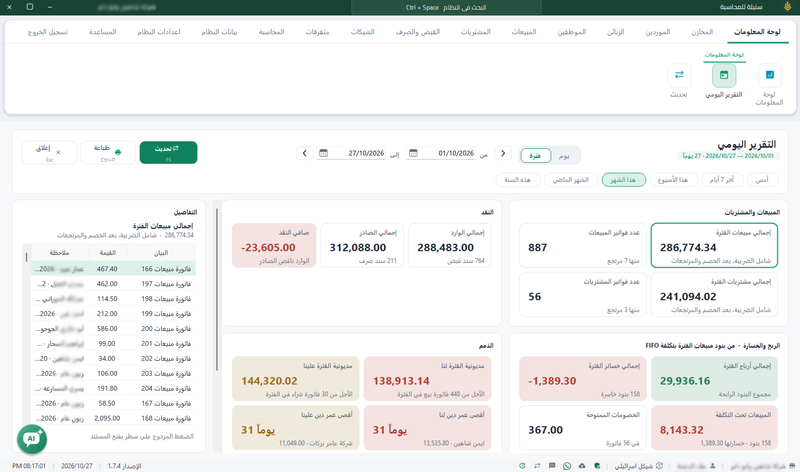
Sonbola is accounting and point-of-sale software that helps you organise the foundation any tax regime rests on: sales invoices and collections, each customer's account and balance, purchases, stock and stock counts, and daily reports.
As for connecting to Egypt's e-invoice and e-receipt systems, we do not announce a ready integration for every case. If your business needs that integration, ask the Sonbola team to confirm its scope and test the right path for your case before relying on it. Details are on the Sonbola in Egypt page; for selection criteria see how to choose accounting software for your shop.
Frequently asked questions
Is turnover under EGP 20 million enough to benefit from the simplified regime?
No. Turnover is the starting condition. You then apply online, comply with the electronic systems that apply to you, and file your returns on time.
Does a small shop need an e-invoice?
It depends on your tax registration and on the obligation decision that covers you. The e-invoice is for sales to businesses; the e-receipt is for sales to end consumers. Check with your registration number on the Tax Authority's website, or ask the Authority or your accountant.
How do I know whether my business is in an e-receipt phase?
Each obligation decision comes with a list of the taxpayers it covers and a start date. The Authority's website offers an inquiry by registration number for taxpayers covered by e-receipt obligation decisions.
Does Sonbola integrate with the Egyptian Tax Authority's systems?
We do not announce a ready integration for every case. Mention your e-invoice or e-receipt needs when you contact us, and ask the Sonbola team to confirm the integration scope and test the right path before relying on it.
Sources
- Masrawy: head of the Tax Authority on joining the electronic systems as a condition (9 May 2025, Arabic)
- Amwal Al Ghad: e-invoice or e-receipt a condition for the simplified regime (9 May 2025, Arabic)
- Masrawy: head of the Tax Authority explains the simplified regime's benefits (13 August 2025, Arabic)
- Masrawy: Decision 420 of 2025, Form (1/10) and required records (12 November 2025, Arabic)
- Comarch: Decision 281 of 2025 on e-receipts (20 August 2025)
- Al Bawaba News: Decision 361 of 2025, ninth e-receipt phase (25 September 2025, Arabic)
- Egyptian Tax Authority: e-receipt obligation inquiry and e-invoice obligation inquiry (checked 6 November 2026, Arabic)
The information is drawn from the Authority's statements and press coverage up to the publication date and may change with later decisions. This guide is for awareness, not tax advice; confirm your case with the Egyptian Tax Authority or a certified accountant.