Palestine has issued Decree-Law No. 4 of 2026 on Reducing Cash Use. It was published in issue 235 of the Official Gazette (Al-Waqa'i al-Filastiniya) on 25 February 2026 and applies from the date of publication. The key point for a shop owner: no cash payment in any transaction worth more than 30,000 shekels.
This guide explains the text in plain terms, shows which of your shop's transactions are affected, how to receive and pay above the cap, and how to record each payment by its method so your books match the bank statement. It is for general information, not legal advice; confirm the details for your business with the Palestine Monetary Authority (PMA) or your accountant. Figures in the examples are illustrative.
1. The law in brief
- The cap: cash payment is banned in transactions worth more than 30,000 shekels, or the equivalent in legal currency, per transaction (Article 5). The draft law had set the cap at 20,000 shekels; it was raised in the final text.
- Changing the cap: the PMA may change it by its own decision after coordinating with the Ministry of Finance.
- All currencies: the law covers transactions in any currency in circulation in Palestine, so dollars and dinars count at their shekel equivalent.
- Periodic payments too: it covers transactions paid periodically or in one go.
- Cash, in the law, means banknotes and coins. Non-cash payment means electronic methods that move the value to a bank account or e-wallet, such as bank cards and electronic transfers.
The law also gives the PMA further powers that may reach you later, including special caps for sectors such as real estate and luxury goods, caps on cheque values and rules for endorsing cheques, and naming transactions that must be paid by non-cash means only (Article 6). Keep an eye on the instructions it issues.
2. What counts as “one transaction”, and why splitting does not work
This is the most important point in practice. The law defines a transaction as any payment, or group of linked payments, arising from one contractual relationship or one economic purpose, even if carried out in stages. The total value includes taxes and the expenses attached to the transaction.
Illustrative example: a goods order from one supplier worth 45,000 shekels including tax. Paying 25,000 in cash today and 20,000 in cash a week later does not turn it into two small transactions; it is one transaction above the cap. The same goes for splitting the invoice in two, or writing a lower value than the real one.
It also follows from this definition that an annual contract (rent or supply) whose total value is above the cap may count as one transaction even if it is paid in small instalments. The text does not spell these cases out, so ask your accountant or the PMA before relying on cash instalments.
3. Fines
- A fine of no less than 5% and no more than 15% of the total value of the cash transaction in breach, without prejudice to any heavier penalty in another law (Article 8).
- The fine may be imposed on both parties: the seller who received the cash and the buyer who paid it.
- The fine doubles for a repeated offence, for splitting the value of the transaction, or for declaring a value lower than the real one to avoid the ban.
- The breach does not void the sale itself; the contract and the obligations arising from it remain in force.
In the example above (45,000 shekels) the fine would range from 2,250 to 6,750 shekels, and could double if splitting is proven. This is an illustrative calculation; the actual fine is for the competent authorities to set.
4. The correction period: where does it stand?
Article 10 requires everyone subject to the law to bring their affairs into line within a period set by the PMA, not exceeding six months from publication in the Official Gazette. The PMA, in coordination with the Ministry of Finance, may extend it for further periods. With publication on 25 February 2026, the original six months end around 25 August 2026.
What happened next? We searched up to 6 November 2026 and found no published decision extending the period, nor any announcement that it had ended. An opinion piece in Al-Quds on 1 September 2026 asked whether the period had been formally extended, without an answer. So: check with the PMA or your bank on the current position, and treat the cap as in force.
5. Which of your shop's transactions are affected?
Most everyday sales in grocery, clothing or restaurant businesses are far below 30,000 shekels and will not change. The law reaches the large deals:
- Supplier payments: a large goods order, or settling a supplier balance under one contract.
- Wholesale: selling a large order to another shop or a contractor.
- High-value goods: cars, complete furniture for a home or office, building materials for a project, appliances and equipment.
- Periodic payments: rent and supply contracts, and any salary or fee where the transaction value exceeds the cap.
- Buying equipment or vehicles for the shop.
6. How to receive and pay above the cap
- Bank transfer: from the customer's account to the shop's account, with a reference number that appears on the bank statement.
- IBURAQ instant payments: a central electronic payment system supervised by the PMA. It sends the payment instantly, around the clock, through your bank's app to an IBAN or an e-wallet number. Limits and fees are set by each bank, so ask yours.
- Bank cards through a point-of-sale terminal.
- Licensed e-wallets.
- Cheques: a cheque is not cash under the law's definition, but the law lets the PMA set caps on cheque values and regulate endorsement, so follow its instructions.
Can part be paid in cash up to 30,000 and the rest by transfer? The text bans cash payment in a transaction above the cap and does not address mixed payment directly. The safer course is to pay a large transaction entirely by non-cash means until clearer instructions are issued.
And one rule with no exceptions: never split an invoice to stay under the cap, and never write a lower value than the real one. That is exactly what doubles the fine.
7. Record the payment method so your books match the bank
Article 7 requires companies, traders and service providers to keep records and documents showing the method of payment. “We received the money” is no longer enough; your records should show whether it came by transfer, cheque or card.
- An account for each method: a cash box for cash, an account for each bank, and one for each wallet. Do not record a transfer in the cash box. Details are in the guide to recording bank transfers and e-wallet payments.
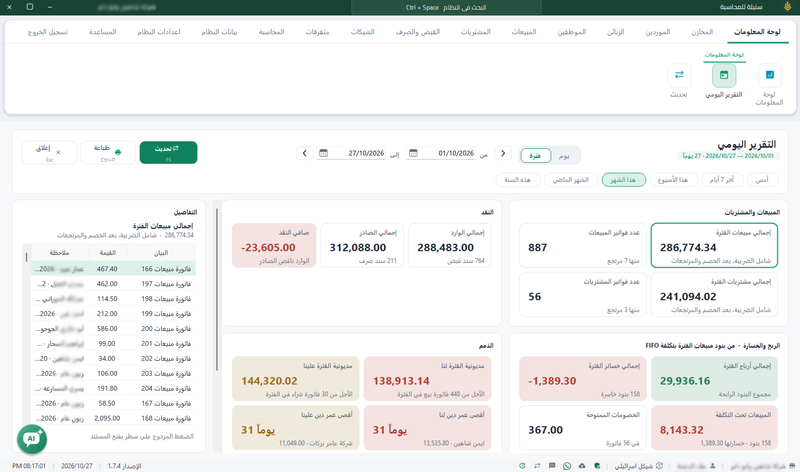
- One voucher, several methods: in Sonbola, receipt and payment vouchers accept multiple lines and payment methods: cash, card, transfer and cheque in one voucher. If a customer pays by transfer and cheque together, each part lands in its correct account.
- The POS: Sonbola's POS supports multiple payment methods, so card sales do not turn into cash on the shift report.
- Postdated cheques: Sonbola tracks postdated cheques with their due dates. See the postdated cheques guide.
- Currencies: if you receive dollars or dinars, record the exchange rate, and remember the cap is measured in its shekel equivalent. See shekels, dollars and dinars in your shop accounts.
- Reference: write the transfer or cheque number in the voucher note, so you can find it when reconciling the bank statement.
If you are looking for accounting software that fits the Palestinian market, with its currencies and cheques, read accounting software in Palestine.
Frequently asked questions
What is the cash payment cap in Palestine?
30,000 shekels or the equivalent per transaction, under Article 5 of Decree-Law No. 4 of 2026. The Palestine Monetary Authority may change the cap after coordinating with the Ministry of Finance.
What is the fine for paying cash above the cap?
Between 5% and 15% of the total value of the transaction, and it may be imposed on both parties. It doubles for a repeated offence, for splitting the transaction, or for declaring a lower value than the real one.
Can I split an invoice into smaller invoices under 30,000?
No. Linked payments arising from one contract or one purpose count as a single transaction even when paid in stages, and splitting to avoid the cap doubles the fine.
Has the correction period ended?
The law set a period of no more than six months from publication on 25 February 2026 and allowed the Monetary Authority to extend it. We found no published extension as of 6 November 2026, so check with the Monetary Authority before any large transaction.
Sources
- Text of Decree-Law No. 4 of 2026, Official Gazette issue 235 (Arabic, copy published by Maqam, An-Najah University) — 25 February 2026.
- Palestine's law on reducing cash use enters into force (Arabic) — Bnews, 25 February 2026.
- 30,000 shekels as the cash cap: the President issues the law on reducing cash use (Arabic) — Al-Iqtisadi, 26 February 2026.
- From the Official Gazette to the market: where are the first-phase results? (Arabic opinion piece) — Al-Quds, 1 September 2026.
- IBURAQ Electronic Payment System — Arab Islamic Bank page, accessed 6 November 2026.