Why a carpenter loses money while thinking he profits
Because profit is usually worked out as the sale price minus the wood. Hinges, handles and runners are forgotten; so are paint, varnish and glue, the carpenters' days, the workshop rent and the electricity for the saws. Each is small on its own, but together they can reach a third of the price. At the end of the month the owner sees plenty of sales and little cash in the till.
The cost formula in three items
Cost per piece = (materials + labour + overheads) ÷ quantity produced
- Materials: everything that went into the piece, boards, wood, foam, fabric, hinges, handles, paint, at its purchase price, with the usual waste.
- Labour: the days of the workers who made it at their daily rate, including the owner if he works on it.
- Overheads: the piece's share of workshop rent, electricity, machine upkeep and consumable tools.
Example: a bedroom set from start to finish
One bedroom set sold for 5,000. The figures are illustrative, not market prices or a customer's case; put your own workshop's numbers in their place.
| Item | How it was worked out | Amount |
|---|---|---|
| Boards and wood | including the usual cutting waste | 1,600 |
| Hinges, handles and runners | by the number of doors and drawers | 250 |
| Paint, varnish and glue | the piece's consumables | 300 |
| Total materials | 2,150 | |
| Labour | 2 carpenters × 3 days × 150 a day | 900 |
| Workshop overheads | monthly rent and power 7,000 ÷ about 20 pieces | 350 |
| Cost of the set | 2,150 + 900 + 350 | 3,400 |
| Sale price | as agreed with the customer | 5,000 |
| Gross profit | 5,000 − 3,400, or 32% of the price | 1,600 |
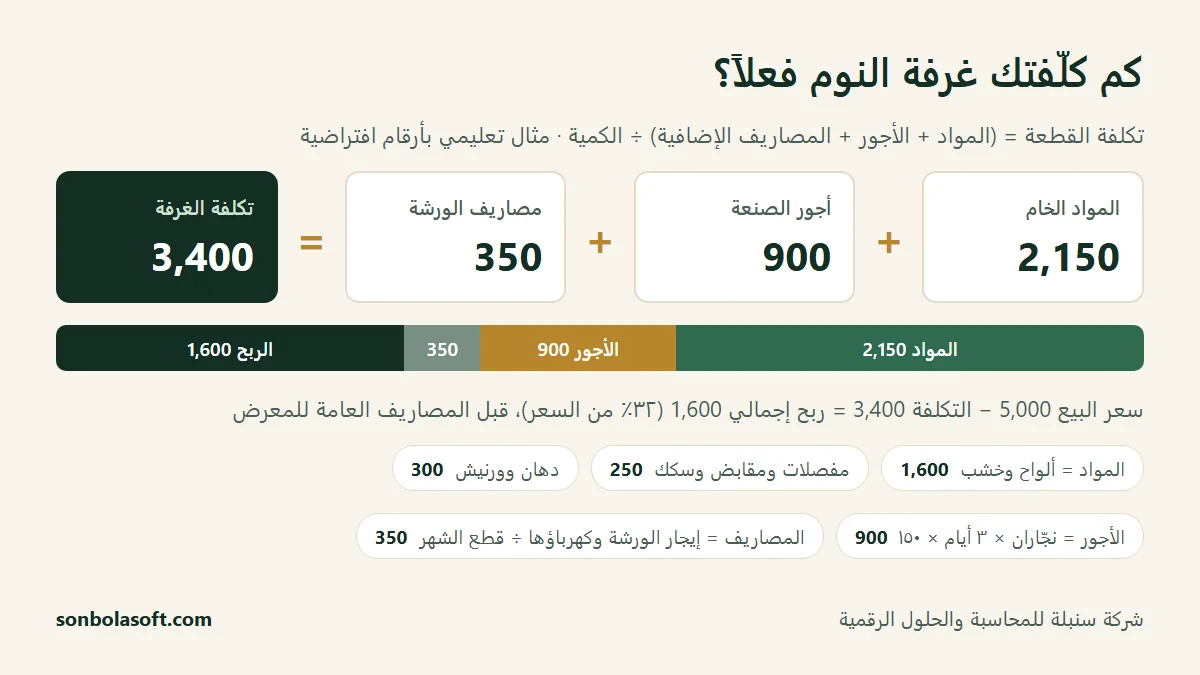
Counting the wood alone, you would think the profit was 3,400, twice the real figure. And this gross profit comes before the showroom's general costs, such as sales staff, advertising, and delivery when the customer does not pay for it.
Five mistakes that eat a workshop's profit
- Forgetting the owner's wage. If you build with your own hands and do not count your day, you work for free without knowing it.
- Ignoring waste. Offcuts and wrong cuts are part of the piece's cost, not a separate loss.
- Quoting with an old wood price. Cost uses the purchase price, but a new quotation needs today's price.
- Mixing the deposit with profit. A deposit is a customer payment, not profit until the piece is delivered and its cost known. Deposits and delivery guide
- Not charging workshop overheads. Rent and power are paid whether you make one piece or twenty, so spread them over the pieces.
When one order makes more than one piece
If you make two identical sofa sets in the same order, add up the materials, labour and overheads of both, then divide by 2. Example: materials 3,800, labour 1,200 and overheads 400 for two sets make 5,400, so each set costs 2,700. Dividing by the quantity keeps the unit cost right when the two sets sell at different prices or times.
How Sonbola does it with a manufacturing invoice
In Sonbola for Windows, Trade edition, this formula runs in the manufacturing invoice:
- Define the product, such as «Bedroom set model 12», as a manufactured item with its recipe: the materials and their quantities.
- On the Stores tab, in the Manufacturing group, choose Add to open a manufacturing invoice.
- The first line is the product and its quantity; the materials follow with negative quantities, since they leave the store.
- On the Manufacturing costs tab enter the labour and the additional overheads.
- Save. The materials leave at their cost, the finished product enters the store at its cost, and the labour entry is posted.
The Production cost report, under all store reports, then shows the cost of each order. The interface is in Arabic; the step-by-step lesson with screenshots is in the user guide (Arabic).
From cost to sale price
Once you know the real cost, pricing decisions get clearer: how much discount can the set take without a loss? Which model earns more although it is cheaper? Does a custom order with unusual sizes deserve a higher price? Review the cost whenever wood prices or wages change, not once a year.
Frequently asked questions
Should I count my own work as the workshop owner?
Yes, if you work on the piece yourself. Your day in the workshop has a price; leave it out and the profit looks larger than it is, and there is no salary left for you at the end of the month.
Which wood price do I use: what I paid or today's price?
The accounting cost uses the actual purchase price of the material that went into the piece. When quoting a new order, check the replacement price: if wood went up, the old price will not buy the boards for the next order.
How do I spread workshop rent and electricity over the pieces?
Add up the workshop's monthly overheads and divide by the average number of pieces a month, or by working days and multiply by the days a piece takes. Pick one method and stick to it.
Does Sonbola work out the cost of a piece by itself?
Yes, in the Trade edition. The manufacturing invoice takes materials out of the store at their cost, adds the labour and overheads you enter, and divides the total by the quantity produced.
Related tasks and tutorials
- Furniture showroom and workshop management
- Manufacturing and assembly
- Furniture deposits, delivery and customer balances
- Sales and collections
Examples use illustrative figures, not market prices, customer results or tax advice. Review your costing method with your accountant. Manufacturing is part of the Trade edition. Windows trial: 30 days or 500 invoices, whichever comes first.